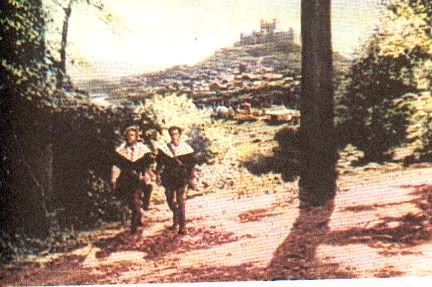
Minggu, 05 November 2006
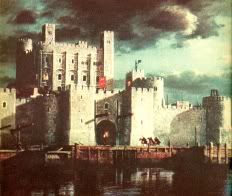
Jumat, 03 November 2006
The Magic of Ellenshaw
 Walt Disney with Peter Ellenshaw
Amongst the credits for Walt Disney’s ‘Story of Robin Hood’ is the name of Peter Ellenshaw, Matte Artist. So what is a Matte Artist?
Born in
specialist and ingenious trick photographer. 'Poppa’ Day had learned his trade and magic from the great French illusionist George Melies. Poppa took Ellenshaw under his wing and guided him not only with his painting on canvas but also on glass, for creating matte background for film.
Matte paintings are usually paintings made on glass, fixed to the camera. There are certain holes left in the painting so the camera can see through the glass and into the set, thus creating the illusion that the set and the painting are one and the same.
After a brief period with MGM, Ellenshaw was noticed by an Art Director involved in the pre-planning stages of ‘
Peter Ellenshaw has left us with a legacy of memorable images from those Live-action films. Apart from his work in ‘The Story of Robin Hood’, who can forget the beginning of Mary Poppins as the camera pans over London at dusk and then zooms onto Mary sitting on a cloud? The atmospheric image of the masts of the ships in the harbour, from '20,000 Leagues Under the Sea’ or even his earlier work, creating the Roman cities in ‘Spartacus’.
For his 102 different evocative mattes of Edwardian
“Walt,” he said,” was the dominant figure in my life for all those years. He talked to me as a father would, I cherished our relationship.”
When Disney died in 1968, Ellenshaw said that, “making movies wasn’t the same any more. I ceased to be interested in film making.”
© Clement of the Glen 2006-2007
Rabu, 01 November 2006
A 'Different' Robin Hood Film
 From 'The Disney Films' By Leonard Maltin:
'Having formed RKO-Walt Disney British Productions Ltd and succeeded in filming a most creditable live-action feature, Walt Disney decided to continue making films in England, with Perce Pearce as his producer. They decided to continue in the action-adventure genre and chose Robin Hood.
This time out, in addition to using an all-British crew, Disney hired a British director as well, a young man who had made an impressive start at Rank studios with such films as 'Trio' and 'Quartet', Ken Annakin. At the time he joined the production, some prepatory work had already been done by Disney and Pearce with their cameraman Guy Green and art director, Carmen Dillon. As on 'Treasure Island' three seperate shooting units were established, one doing action work on exterior location and two doing interiors at Denham Studios. Disney spent part of the summer in England working closely with Annakin. The director recalls
"I remember talking about the original Errol Flynn 'Robin Hood' and I looked at it, just to get an idea what had been done before, because I never like to do anything twice. Walt didn't seem very worried about seeing the original and in fact I doubt he ever did. His approach is always that the film is a Disney picture and therefore, because of his attitudes and his approach, the picture is bound to be different from anything else made on that subject before."
That is exactly what happened of course, the Disney film adheres to the Robin Hood legend, yet it is a work unto itself. One is hard pressed to make comparisons between the Disney Robin Hood and earlier versions, not because one is better than another, but simply each one is different.
This is an extremely 'good looking' film as well. The locations are beautiful with lush green countrysides, the sets are truly formidable and realistic. The seemingly effortless pacing and knowing use of camera angles and cutting is doubly impressive when one considers certain background facts. For instance, Annakin has vivd memories of the difficulties in shooting Technicolor at that time.
"It was the very elaborate three-strip system with a very immobile camera. When you wanted to reload the camera in it's very heavy blimp, you had to have it lifted on chains and it took the first-class technicolor crew a minimum of eleven minutes to reload the camera. After every single shot the camera had to be opened and the gate had to be examined; the prism was the great thing because this was the light splitter which gave the registrations on the three strips. For this reason, if you were making a big picture like 'Robin Hood' you had to be very certain you were not wasting set-ups or wasting shots because it was a big industrial process every time to set up your camera"
The use of story boards was new to Annakin, "but it appealed to my logical brain very, very much" and prompted ingenious scenes such as the first meeting between Prince John and the Sheriff after King Richard has lefy, played on the balcony of the castle against a brilliant but ominous orange sky at sundown.
Time has been kind to the film, as so many inferior films in this genre have followed it: today it seems better than ever.
Disney's 'Robin Hood' strikes a happy medium, leaning heavily on strong characterisations but placing them against a colorful and sumptuous tableau that gives the film a fine period flavor.'
7. Marian Presents The Prize

“Good bowman,” said Queen Eleanor, “step forward.”
“My lady paramount,” said Hugh Fitzooth, “I beg a favour, let the golden arrow be given to him whose arrow hit the mark first and no less truly than mine.”
Marian laughed, “thank you Robin,” she said, “it will remind me of this day where ever I may go.”
“You leave Nottingham?” Robin asked.
“Today, replied Maid Marian. “I journey with the Queen to London.”
Marian laughed, “thank you Robin,” she said, “it will remind me of this day where ever I may go.”
“You leave Nottingham?” Robin asked.
“Today, replied Maid Marian. “I journey with the Queen to London.”
The Queen rose and Marian turned to attend her. Robin rejoined his father and Prince John lent over and began whispering to his new Sheriff of Nottingham.
6. Robin Splits The Arrow

There were three archers left, including Red Gill, in the service of the Sheriff.
“The crowd is not cheering your bowman, De Lacy,” said Prince John, giving him an awkward glance.
“My men have been gathering some small part of the new taxes, my lord,” he answered, “Red Gill will win for us.”
Red Gill stood by his marker peg and took aim, then sent an arrow that whizzed through the air and pierced the outer edge of the inner circle. There was a generous amount of applause for the Sheriff’s bully and he stood back and confidently said to Robin, “can your tuppenny bow do better than that my beardless whelp.”
Robin ignored him and quickly sent an arrow into the dead centre of the inner circle, sending a deafening din from the crowd.
“Forgive me sir,” said Robin to his father, “if beating this man, I have robbed you of your chance to win!”
“Lad, no man is beat till he admits it,” said Robin’s father.
Calmly Hugh Fitzooth put his toe to the marking peg and took aim, then let fly. TWANG! Hugh’s arrow had split Robin’s arrow down the middle. As the crowd roared, Red Gill slunk away.
5. The Archery Contest

The shooting match was held on the outskirts of Nottingham. The area was surrounded by long lines of stalls and booths, where groups of commoners were gathered, waiting for the contest to begin. The butts were roped off in a long green meadow where amongst a group of men, stood the minstrel Allan A Dale plucking his lute. His keen eyes espied a group of local archers whom he softly warned.
“Beware, O ye archers of Nottingham Fair,
Of our new Sheriff’s hirelings beware-oh,
Since they levy a tax on thy chattels elsewhere,
They may here tax thy bow and thine arrow.”
From miles around, sunburnt bowmen had gathered to shoot for the prize of a golden arrow to be presented by Queen Eleanor.
One by one the independent archers were beaten by the Sheriff’s men, until only Hugh Fitzooth and his son Robin remained to challenge De Lacy’s men.
“You have done well,” said Prince John to the Sheriff, as he watched from the Royal Box.
To the gasp of the many hundreds of spectators, the Marker called that the final match would be shot at a distance of six score yards.
“My Lords!” He called. The upshot is: Tepus out! Clifton Out! Adam of Leslie out!”
4. The Plans of Prince John
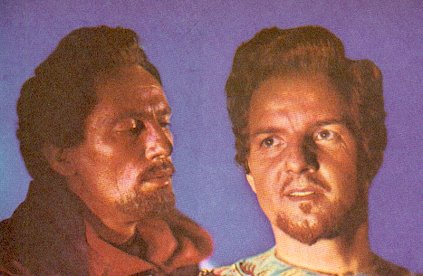
Prince John stood on the battlements of Nottingham Castle and watched as the Crusading army’s rearguard disappeared into the sunset.
“De Lacy!”
A bearded attendant stepped out of the shadows and stood alongside the king’s brother.
“My Prince?”
“Kings have died on Crusades,” Prince John murmured. “The Prince in the line of succession needs trustworthy men about him. How say you?”
“My lord,” replied the rather sullen faced De Lacy. “I am yours as the blade of my sword is to the hilt.”
“Good, You shall be my new Sheriff of Nottingham,” promised John as the two men stood together.
“As Sheriff,” the Prince went on, “you shall enforce the trespass laws in Sherwood Forest, not with Richard’s lenient hand, but to the very letter of those laws. For such a task we’ll need a larger force.”
“We’ll need an army,” the new sheriff amended quickly.
“Aye an army!” The Prince agreed, “an army of hard shooters, who can feather their arrows at nine score yards, should their prince so much as whisper his command.”
But De Lacy looked worried.
“Can your estates support so large a force?”
“There will be new taxes,” the Prince replied.
“My lord,” De Lacy said, “You have a kingly mind.”
Prince John smiled.
“Bestir yourself, I shall expect to see the finest bowman in the Kingdom wearing the sheriff’s livery.
“Give me but a fortnight Sir and I’ll have such men as you wish enlisted.”
“Good,” replied the Prince. “You shall show me what they can do at Nottingham Fair.
Langganan:
Komentar (Atom)