Tampilkan postingan dengan label theory. Tampilkan semua postingan

Jumat, 17 Maret 2006

Reflections #6 - Annihilation: Prologue

Page 1: Who is the little Tinkerbell sitting on Thanos' shoulder? Thanos and Tinkerbell are incompatible, like Vibe and cool.

Also on Page 1: If Thanos loves Death, and Death is now in the form of a little girl, does Thanos have a Lolita complex? Of course, with him, that's the least of your concerns.

I think Death is trying to convince Thanos to help stop this. . . force (see, I'm still not spoiling it for you, isn't that nice?). See, I believe Thanos is still in love with Death, or at least worships it to an extent. Death knows this, and is taking advantage of the situation, as nigh-omnipitent cosmic being are wont to do with puny mortals. And the way Death phrases things on that first page, well, it's a little disturbing. (Thanos' lines in bold, Death's in italics):

'Something comes. Yes. Something wonderful. Death? I am with him, yes. And? Learn from this one Thanos. This one knows me intimately.'

I'm sure by now you see what I mean about disturbing. But there's something else. It's almost like Death is trying to egg Thanos on. Death's talking about its new boyfriend, how close they've gotten, even though Death probably doesn't even really like the new guy, just to get Thanos off his butt and busy winning Death back, or busy killing the new guy. Whichever, really. And I think it makes sense, in a way.

See, the big threat is out to destroy anything that opposes its existence. And the way this thing sees it, all living things are a threat to its life. While this is true in a sense, mainly if they wind up competing for the same resources, but it's still over the top. Irregardless, the Annhilator seems determined to wipe out all life, which would seriously upset the balance. And Thanos should remember what happens when you do that.
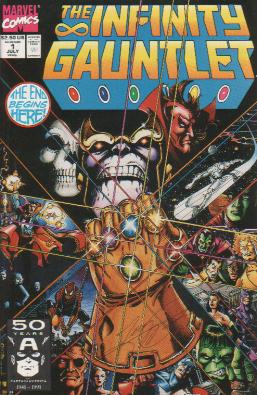
Once upon a time, Thanos had the Infinity Gauntlet, six gems that gave him control over the whole universe. First thing he did? Kill half the people in the universe, to prove his love for Death (now there's a guy who got stuff done. None of this dicking around with multiverses and sentient satellites like Alex Luthor). Still, when Galactus, the Stranger, some Celestials, and a whole bunch of others on that power scale showed up to oppose Thanos, Death sided with them. I believe it did so because he was a threat to all existence, and if you destroy everything, then there is no Death, because there's nothing left to die, you follow?

This new threat isn't quite at that level (after all, Thanos defeated the very essence of the universe itself), but it's still more than capable of wiping out life. And I'd say that once again Death is looking at the big picture, because while everything will die, someday, it can't all die at the same time. To prevent this, Death's trying to get someone who can make a difference to do so. Granted it's in a somewhat obtuse and childish manner, but hey, Death has chosen to masquerade as a child, it might as well use their tactics too.

Addendum: I was looking online, and it seems Thanos wanted to wipe out half the life in the universe at Death's request. Which raises the question of why Death betrayed him during "Infinity Gauntlet". Possible explanation #1: Death felt he was letting his ego get in the way, that it was becoming less about the mission and more about him. Possible explanation #2: Since Death never seems to actually speak to anyone, Thanos was guessing at what Death desired, and being sanity-challenged, Thanos figured it wanted half of all life eliminated.
Sabtu, 11 Maret 2006

Reflections #5 - Ultimate Spider-Man #91

There's just one question I want to pose today: Where is Aunt May really going?

I don't know about you, but I don't buy the whole "getting together with friends from work" thing. You get that dressed up for a work get-together? She's definitely seeing some one, but who? Two possibilities leap to my mind:

One, it's a member of Nick Fury's staff (like an accountant or something) dating Aunt May to get her in trouble and further mess with Peter's life. Because, you know, Nick Fury gets his kicks from stuff like that. Heck, Fury is probably in charge of Deadpool and his Mutant Loser Brigade. And now I'll stop before I start ranting.

Two, she's dating J. Jonah Jameson. I can't remember if he's married in this continuity, but if he isn't, their mutual distrust of Spider-Man could be a connecting point. Jameson may not believe Spidey is evil anymore, but he has (understandable) questions about someone who swings around in a weird costume punching people. And Aunt May, well she made her feelings pretty clear when Peter was going to tell her he was Spider-Man.

Plus, I can recall at least one or two occasions where May put Jameson back on his heels, particularly when JJ offered Peter the job at the Bugle. Jonah seems to like/respect people who aren't intimidated by him. Ben Urich is constantly giving him crap, but Jameson lets him because Urich gets results, and because Jameson trust people who don't let him push them around, up to a point. So that may make her intriguing to him.

Seriously, how badly would that mess with Peter, his boss dating his aunt? He might be better off with the "Nick Fury is trying to mess with you" option.

Senin, 06 Maret 2006

Things I Think About #21

I was thinking about how I said Johnny Storm would have no chance with Carol Danvers, and I asked myself who would, because I have too much free time. The answer came swiftly: Hawkeye. Is there a woman he's been on the Avengers with he hasn't slept with, or at least made a pass at? Black Widow, Wasp, Mockingbird, She-Hulk, I'm sure Tigra at some point, that's just off the top of my head. The man likes to date in the workplace, no doubt. Except the Scarlet Witch.

And that's when I realized that all that was needed to stop House of M was for Hawkeye to have hit on the Scarlet Witch. Given his remarkable skill with the ladies, he would surely have scored, and Wanda would have real, actual children, as opposed to the fake ones she conjured while she was with the Vision. And guess what? Crisis averted, insanity forestalled by loving real, not conjured up children.

See, I've realized Wanda remembered her "children that weren't", long before Disassembled. She missed them (understandable), and since making fake kids is a dangerous path to tread, she wanted to have real children. And who better to help than the Avengers resident stud pony, Clint Barton? Except he wouldn't. Whether it was because he refused to get between her and the Vision, because he was afraid of the damage Quicksilver would do to him when he found out, or because he had a headache (admit, you knew that joke was coming), he turned her down flat.

Desperate, she asked other teammates. Jack-of-Hearts was too radioactive. Scott Lang already has a daughter he barely gets to see, he declines. The Vision, well she'd tried that before. That sent her into a realm of pissed-off hurt like you've never seen. And look what happened. Jack-of-Hearts, already blowed up, comes back and blows up Scott Lang. Vision gets ripped in half by Wanda's friend, the She-Hulk. Shulkie proceeds to knock Kelsey Leigh (a woman who has two real children, even if she can't be with them) for a loop, and then Hawkeye blows himself up real good.

It all connects. And honestly, is this ludicrous idea any worse than what Bendis handed us?

Seriously, is it? I mean besides the obvious fact that it falls apart if Hawkeye did proposition her at some point.

Selasa, 28 Februari 2006

Characters Who Have Killed

I've got an idea for a little study, but I need your help. Yes, just like Meatloaf at the Special Olympics, I am asking for the mighty comics bloggers to lend a hand to this poor boy. Now that I've run that into the ground, here's what I'm talking about.

I need to know about heroes who have killed, but have since sworn not to do so again. The death doesn't have to have occurred during their career as a costumed hero, it can have happened during an earlier part of their life (soldier, cop, mugging victim, etc.,). Cassandra Cain would be an example, even though she ended up killing again. In fact, if you could include whether they've kept that vow up until now, I'd appreciate that.

One thing, it needs to have at least been something referenced by the character at some point. What I mean is, Batman and Superman both used to kill criminals, but now they don't (Mostly? Is that time Supes killed 3 Kryptonians in continuity?). What I'm not clear on is the specifics of that change. Was there a point in their books, where each said "I'm not going to kill anymore", or did the writers just change the character at some point with no real explanation provided as to why the character's beliefs about killing had changed. If it's the former, by all means include them. If it's the latter, you can mention them, but I'm not sure that I'll count them.

The vague impression I've got right now is that in American comics, it's pretty much all-or-nothing. Either you don't kill, and never have (Spider-Man), or you killed before you were a "hero", and you continue to do that (Wolverine). In Japanese comics, I've noticed at least a few characters who for various have killed quite a lot at an earlier time in their life, and have since sworn, either to themselves or someone else, not to do so again (Kenshin and Ryoko come to mind quickly).

I may be over-generalizing here, but in manga, characters seem to become somewhat less bloodthirsty, or at least, killing is truly a last resort, only when they can't stop the person otherwise. In comics characters either remain the same, at least within the same version. There seems to be a difference between original (Earth-2?) Batman, and the current one. Barring that, they become more violent. They kill, and that causes a descent into greater darkness. I'd probably put Green Arrow and Colossus into this category. It just doesn't seem that characters go the route of getting less dark.

So any information you have on characters, cultural differences, your opinions based on what I've thrown out here, let's hear it.

Minggu, 12 Februari 2006

Things I Think About #15

Is 'dwell' one of those words that can't be used in a positive manner? I saw a sign today, it said, "Dwell on the positive things", and it just seemed so wrong. I mean 'dwell' seems like the less gothic brother of 'brood', something you do over mistakes, or missed opportunities. I figure you 'reflect' on positive things, or 'focus' on them. Just something that occurred to me while I was getting gas this morning.

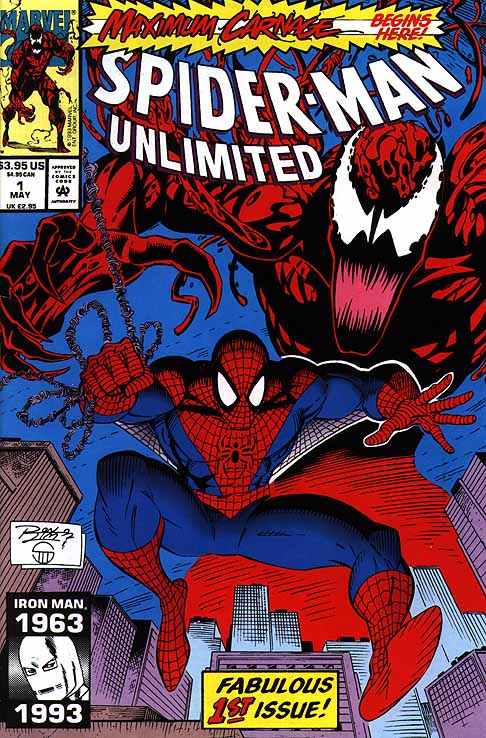
As to the main crux of this post, Maximum Carnage. For those who aren't aware, this was a 14-part storyline spanning 5 Spider-Man books in the summer of '93. Carnage escapes from a mental institute, forms a 'family' with four other psychos (Shriek, Spider-Doppelganger, Carrion, and Demogoblin) and proceeds to run rampant, slaughtering at least hundreds of people before his defeat. Somewhere along the line, I think Spectacular Spider-Man #203, it was pointed out in the letter column that this whole thing was idiotic because the big teams were nowhere to be found. They had a point. You did have Spider-Man and Captain America, but also Venom, Black Cat, Firestar, Cloak and Dagger, Iron Fist, Morbius(!), and Deathlok. Wow, that's pretty lame. No wonder the heroes kept getting their asses kicked. The question becomes, where the hell were all Marvel's teams? Through exhaustive research, I've determined what teams said they were doing that summer, as well as what was really going on.

Well, since it was confined to New York City, you can eliminate teams from other countries (Alpha Flight, Excalibur) and other states (Great Lakes and West Coast Avengers).

There was only one mutant (Shriek) in Carnage's group, so you could probably forgive the X-teams for their absence, but we'll lump them in too, so for the record:

What they said:

X-Force was scattered all over the world. Some were captured by Externals, the rest were on the run from the same, and Cable was doing his own thing.

X-Factor was trapped in Genosha, dealing with the usual "mutant in Genosha" crap.

Uncanny X-Men had Illyana Rasputin's impending death, and Colossus' impending defection to Magneto.

X-Men had the "What is Betsy Braddock doing in an Asian body again?" fallout, and the subsequent trip to Japan.

The Fantastic Four were distracted by Johnny being on trial for burning down part of Empire State University.

The Avengers were dealing with some group of alternate reality losers called the Gatherers.

The truth is:

Excalibur was involved in some Multiverse mess they didn't even understand. The GLA was teaming up with Alpha Flight to stop a giant sturgeon that escaped from Saint Cloud University in Minnesota. And the West Coasters were dealing with Wonder Man, Scarlet Witch and Iron Man's simultaneous mental breakdowns. Between Wonder Man crying about the time the Master Pandamonium had Wanda's babies for hands, and bit Wonder Man with them, to Wanda crying about how the babies tore their gums on Simon's cranium, to Tony insisting they were all pink Titanium Man's, that's a lot to deal with. Then Wanda made them all forget her craziness, and Bendis had his opening.

The X-groups were all taking it easy, in preparation for yet another stupid X-over. Wolverine was busy drinking a lot, after Editorial told him Magneto would rip out his Adamantium in October. The X-Men were still sore about that time in Secret Wars when Spidey found out they were going to bail on the heroes and jump to Magneto's side, and Spidey proceeded to whip them (Before Xavier mindwiped him. Bald Asshole). X-Force was mad about that crossover they had with him, where MacFarlane managed to draw them even worse than Liefeld did. X-Factor couldn't leave Genosha, because Quicksilver refused to leave just to have to come back after Cortez kidnaps his daughter.

The Fantastic Four were actually distracted by Reed's moping about the fact Editorial was going to let Doom "kill" him soon. Sue was busy designing her "slut" outfit, Torch was adapting to Skrull sex, and Ben was mad that when Spidey tried to bring the Torch to jail, he got Wolverine as part of his team, and Wolvie clawed off half of Ben's face.

The Avengers were reeling from the message they would be taking part in the X-book crossover "Bloodties". Besides, they were having trouble with a group lead by a guy named "Proctor". Carnage's group would have wiped the floor with them. If that's false, why didn't Captain America call them in, huh? Man, the Sersi/Crystal/Black Knight Avengers were lame.

The only team I couldn't find anything on was the New Warriors. For whatever reason, they chose not to show up and help their teammate, thus failing to show just how good they were on a big stage. Maybe they recognized Maximum Carnage for the amazing suckfest it was, and voted to stay clear. But when you think about, Firestar is the only one who went on to bigger things. She joined the Avengers, what's Speedball left with? Sure Marvel Boy - I'm sorry Justice - got to join Earth's Mightiest, but that was all because of Firestar. I guess being willing to take part in a horrible mess, and prove yourself as a team player has its benefits, huh?

Good God, Marvel was terrible in the '90s. No wonder I gave up on comics part way through the decade. Well, that and my extremely limited funds.

Selasa, 24 Januari 2006

What Is The Appeal?

I tell you, to this day I can't figure out why exactly I was excited by Joe Casey's Uncanny X-Men. I mean, I know why I had zero interest in Morrison's X-Men. It was a team with Emma Frost, Scott Summers, and Jean Grey, one of whom shouldn't be a hero, and the other two I'm sick to death of. But Casey's team, for some odd reason, worked.

Archangel: I've haven't really liked him since he went back to the birdy wings. I'm sorry, but those metal wings were frickin' awesome. And he was periodically psychotic, and throwing blades out of the wings, cool! Without them, I thought he'd be kind of lame. But he took over, became the leader. He was kind of bossy, but that was made sense, most of the other people on this team are stubborn, and not big on following commands, so you need someone to rein them in.

Iceman: He became the Guy Gardner of the team, the character I could hate without reservation (though I've never read anything with Gardner in it long enough to hate him). He was a smug, arrogant jerk, who gave the newbie on the team a bunch crap, and even talked crap towards his friends. Still, he was always there in a fight, even when Black Tom impales him with a tree branch (though that's from the Adequate Chuck Austen period, before he started to suck).

Wolverine: On certain occasions, I need a character that likes to maim other sentient beings. Plus, he likes to give whoever is running the team a lot of static. Down with authority! Kalinara's glaring at me right now, while holding a Cyclops poster.

Nightcrawler: I remember when Bendis started New Avengers, he said Spider-Man and Wolverine were one of the great unintentional comedy teams in comics. I wouldn't know, they haven't spent more than five pages together in the entire book so far! Besides, Nightcrawler and Wolverine form a great 'buddy cop' tandem. "Come on Logan, I'm tired of having to teleport you away from the cops for killing people whenever we go out drinking." Come on Elf, lighten up a little." Hmm, I don't think I've quite captured the essence. Whatever. Teleporting is cool. So is speaking German. Plus, he tries to be funny without being good at it. And while not a religious person myself, I always found Kurt's faith to be kind of an interesting facet, and while I didn't think he would really try to enter the clergy - he's too much of a swashbuckler to take a vow of celibacy, like Hal Jordan, except not eternally concussed - I thought it made things kind of interesting until Horrible Chuck Austen decided Kurt was being mentally manipulated the whole time. Cripes.

Chamber: I knew nothing about him. Still don't know much other than he's British, telepathic, ran with Generation X, and can fire energy blasts. I'll be straightforward: I HATE telepaths. For some reason, the whole idea of people being able to get in someone's head bothers me. Actually I know the reason, I wouldn't want people being able to get inside my mind, how rude. And I wouldn't believe them if they said they would never do that to me. But one whose ability is basically just developed to the point of communication, like Chamber's, plus he has a different cool power, plus he didn't want to join the team initially, and never seemed totally onboard with it, though that may be because he was gone so frequently.

Stacy X: Some people hate her. I'm not one of them. Before Austen turned her into Super-Slut, I thought she was progressing nicely, maybe making a few friends, or at least people who trusted her (Logan, Chamber, Nightcrawler). Then Horrible Chuck Austen. . . well, I've said it all before. People didn't like a character who's an 'escort'? Fine, it's called "character development". Watch the character "develop" over time into someone who maybe isn't quite as rude, but still independent, and has friends, and isn't hitting on every person in the Mansion (which was Austen's fault, God I HATE CHUCK AUSTEN!).

The thing I notice is the symmetry. You have two old-school X-Men (Archangel, Iceman), two 2nd-generationers (Wolverine, Nightcrawler), and two relative newbies (Chamber, Stacy).

I think what made the team work was a bunch of them didn't like each other. Drake hated Stacy. Stacy hated Drake. Archangel had never liked Logan. Logan has never gotten along with a person who called themselves his "leader". Chamber really wished he could still be with his pop star girlfriend. Kurt's supposed to be the leader, but he didn't really want the responsibility. If you throw in the Juggernaut or Northstar as the 7th member (all good teams just seem to have seven members, don't they?), that's a team full of abrasive personalities. But they come from enough walks of life, with enough different powers, that they could have been in any number of different stories.

Sadly, Casey didn't last. Nothing good ever does. But, we'll always have those ten issues or so.

Sabtu, 21 Januari 2006

Things I Think About #11

Why is Watchmen regarded as such a great piece of work? I'm not criticizing it, as I've never read it, just curious.

Is Grant Morrison's Seven Soldiers in continuity with the rest of DC, or is it like All-Star Superman, off in it's own little world?

What was the reason for leaving Earth-2 Lois and Superman, Superboy, and Alex Luthor alive in a pocket dimension? Was there some reason why they had to survive the Crisis outside of the universe?

That being said, I believe one of them is going to die in each of the remaining issues of Infinite Crisis. We lost Superboy in #4, I think Lois will die on the 2nd page of #5, because it turns out that getting back to Earth-2 doesn't help when you're like 900 years old. This leads to Old-Superman going after current Superman in a grief-stricken rage, before realizing he's been used by Luthor. He'll die in #6 against Alex, before Alex gets taken out in #7, by Donna Troy and Jade. Naturally they will perish in the process. The grief of losing two more girlfriends causes Kyle Rayner to lose it and don the mask to become Ion, the Avenging Green Lantern!

And why the hell would Peter Parker let Tony Stark design his new costume? Why not Reed Richards? Tony Stark builds armor for people who lack powers. Reed Richards builds uniforms for people with powers, so the uniforms work with the powers, such as being able to stretch, or resist high temperatures, etc.

Or Peter could just, you know, keep the same costume he has now.

Jumat, 20 Januari 2006

Things I Think About #10

Beware, this is me getting my nit-picky fanboy on.

Harken back to the OMAC Project mini-series. I don't remember which issue it was, 4 or 5, but an OMAC is getting ready to kill Rocket Red #4. No worries, Maritan Manhunter on the job. Except, the OMAC knows about Martian vulnerabilities, so it ignites, J'onn gets burned, he can't stop the OMAC, no big deal.

Except. . .

In an arc in JLA, J'onn overcame his vulnerability to fire, with the help of a woman named Scorch, falling in love in the process. Unfortunately overcoming that lead to his reverting to an earlier form of Martian life, that almost ended the world, but that's not the point.

At then end, as J'onn is sitting next to Scorch's comatose form, he comments he isn't completely vulnerable to fire anymore, just fires of emotion. I assume that means a fire set out of hatred, or fires set out of love. I'd guess the fire starter leaves a sort of psychic imprint behind with the fire, and J'onn being a telepath, he picks up on it.

Anyway, my point is, there wouldn't be any sort of emotions behind a computerized defense system. It was just the OMAC initiating its programmed response. So it shouldn't have worked. J'onn should have kicked it's butt, end of story.

Ah well, the whole 'fires of emotion' thing was kind of ambiguous.

Minggu, 15 Januari 2006

The Team Role

This stems from a conversation Len and I have had the last couple of Fridays. Comics did a lot of things wrong in the '90s by most accounts. On the Marvel side, there were entirely too many books and crossovers with "X" or "Maximum" in the title. But one thing Len and I agreed was that Marvel did the right thing with their teams, mainly keep them separate entities. Think about it, for those who read them, what is the difference between Uncanny X-Men and X-Men right now? Multiple characters seem to appear in both books, and is there really anything different about what they're doing?

When X-Men originally started, it was set up as different from Uncanny. Look at the rosters:

Uncanny - Jean Grey, Storm, Colossus, Archangel, Iceman, Bishop
X-Men - Cyclops, Beast, Wolverine, Psylocke, Rouge, Gambit, Jubilee (sometimes)

Uncanny seemed to deal with more social and political aspects. There was more talking, more diplomacy, and then at the end of the story, a BIG explosion. By contrast, X-Men seemed to take the style of "Diplomacy? Screw that! We've got Wolverine and Jim Lee art! Let's have battles and curvy women!" Or as Len put, 'X-Men was lots of Sentinels getting destroyed constantly.'

You had X-Factor, the government team, going where the U.S. told them to, including to a Middle Eastern country to defend a regime the government apparently supported from the Hulk and the Pantheon. Granted that was in Incredible Hulk, but Peter David was writing both books, so it could have just as easily taken place in X-Factor.

Meanwhile, X-Force is the hardcore team that deals with Cable's crap. They find the Mutant Liberation Front, they stomp on it. If it's in Antarctica, fine, go there, shoot some people, blow stuff up. If it's in the Statue of Liberty, or Prague, fine there too. In fact, they would seem to be the kind of threat X-Factor would be called in on.

Then you've still got the Avengers (for your everyday Earth-threatening problems), and the Fantastic Four (I think Mark Waid had the best idea, that they're explorers, with the others coming along to help Reed. Plus fighting the Skrulls). Actually, I liked that each major team sort of had their own primary alien problem. Avengers had the Kree, FF had the Skrulls, and the X-Men have the Shi'ar. The New Warriors dealt with typically smaller stuff, closer to street level, while serving as a learning opportunity for what is supposed to be the next generation of heroes (I know, Teen Titans rip-off). I mean, the differences aren't huge, but they are there, so each team can sort of fill a niche.

Anyway, that still exists to some extent, though not so much with the X-books, though X-Factor may be an exception to that, but in theory New Avengers and Fantastic Four still play different roles within the Marvel U.

Anyway, this brings me to a question for my DC-oriented readers: How would you define the roles of the teams in DC right now? JLA (if they still existed. It's down to what Black Canary, Dawn, and Green Arrow)? JSA? Teen Titans? Outsiders? Where the Freedom Fighters turned into cannon fodder because their team showed no recognizable purpose? Am I missing teams? What do you think?

Kamis, 12 Januari 2006

Destiny vs. Responsibility: Has JMS's Mysticism Destroyed Spider-Man?

I gotta confess, I kinda like it when my titles look like something you'd see on a dissertation, or at least a master's thesis. Anyway, this isn't about "The Other", so relax. If you remember, I did a post last month, right before Christmas, where I suggested Uncle Ben be reborn as a Green Lantern. At the time, I mentioned that train of thought came from a different inner monologue I was having, related to a discussion at Comics Should Be Good (kelvin probably remembers this), about whether Straczynski's recent stuff tainted his early Amazing Spider-Man. A fellow by the name of Matthew Craig had some opinions on that, which he shared, and I wasn't sure at the time whether I agreed. Here are the comments that stood out the most:

'It's (Spider-Man's story) about determining one's own identity in the face of the realization that the world is a cold and potentially dangerous place that might try to decide things for you. The World! Not a MYSTICAL SPIDER-GOD.'

Also:

'If it (Peter getting bitten and receiving the powers) was meant to be, how is it a story about a fairly ordinary guy like the rest of us. If Uncle Ben was meant to die and the ability to save him taken out of his hands by Destiny, how can it be Peter's responsibility?'

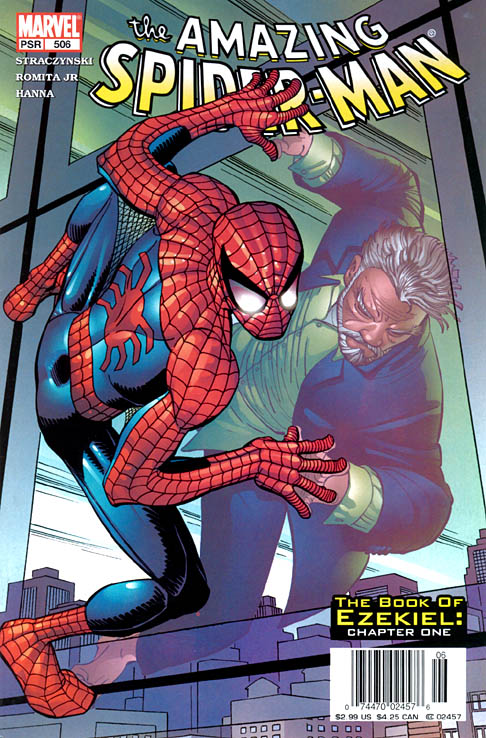
So, is Mr. Craig right? Has Straczynski taken control out of Peter's hands, and in the process destroyed part of the core character? I went to Amazing Spider-Man #507 for some help. In the issue, Peter meets a roughly eight-foot tall mass of brown spiders called the Gatekeeper. Peter gets bitten several times and falls into a sort of dream state where the Gatekeeper explains things to him, specifically why Peter? A few excerpts:

'There were so many other on that day, in that room, together, there - with the spider.' That's certainly true.

'Because you were a hunter without teeth. You were chosen for your rage.' Ok.

'Why you? Because of all those who were there that day, there was only one hunter.'

Ok, I can see how one could interpret this to mean that it was destined. But here's the phrase I'm seeing: "there was only one hunter." To me that suggests, that on that day, Peter was simply the only qualified candidate present. Maybe it was that spider's job to pick someone to be the 'totem' as Ezekial described it, but there was nothing that said it had to choose that very day. At least not until it got hit with the blast of radiation. At that point, the spider had no time left to search for the person who best exemplified what the spider-god was looking for, so it chose the best out of the limited field it had available. And on that day, in that place, the field of candidates was one: Peter Parker.

And what was the qualifier? That he had rage. Specifically, that all these years Peter has been picked on and bullied, beaten and humiliated, and he's just had to take it, because he's too weak or there were too many of them. He lacked the power to do anything about. Well, I'll be honest, that description could fit any number of other kids in high school, probably millions, worldwide. Hank McCoy, the Beast, was a smart guy. Before his mutation emerged, there's probably a real good chance he got picked on, being a nerd and all. So couldn't he have sufficed? Maybe, maybe not, but it raises - to me at least - the idea that Peter just drew a good (or bad) hand.

So does all this mean it wasn't destined to occur? No, for all we know, a Celestial altered events so that the spider got hit with radiation leaving Peter to get bitten. Different force behind it, same result. But there's no evidence of that. Another thing there isn't any evidence of is that Uncle Ben was destined to die, at that time, anyway. We've got no proof that a spider-god with only enough power to have one true totem (or is it two? Does Arana count?) has sufficient power to twist things so The Burglar would wind up at the Parkers', so that he could shoot Ben. If you start saying that was predestined, then where do you stop? Captain America was destined to be trapped in ice for how ever many years before the Avengers found him. Bruce Wayne's parents were destined to be shot. I suppose it all boils down to how much control you want to believe you (or your comic characters) have over your (their) life.

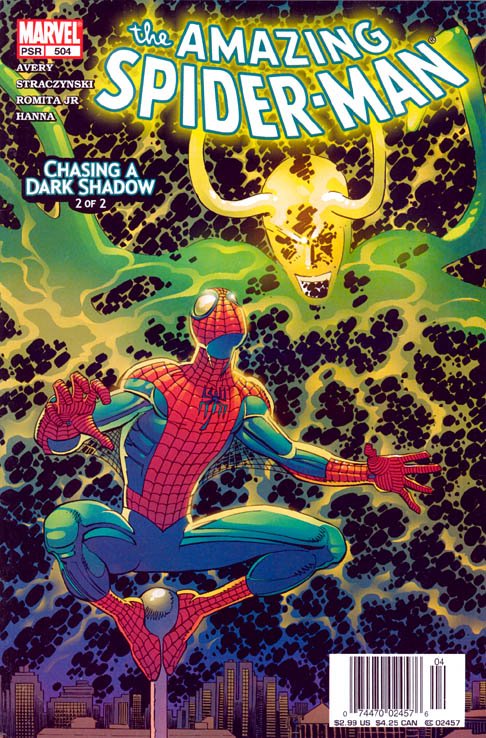
One other idea: Who says the Gatekeeper is telling the truth? I brought this up in the original discussion, that spiders in mythology are typically tricksters, and when Spidey teamed up with Loki to fight the chaos goddess, Morwen, she states that Peter, not Loki, is the person she wants to enlist, because Spidey 'has much of the trickster in him'. And she's right. Peter does fight evil a lot, but webbing Jameson's pants to his chair? Playing pranks on the Human Torch? Making fun of the Vulture being bald, or those ugly green and yellow outfits Doc Ock used to wear? None of that is what I'd call fighting evil.

The Gatekeeper said Peter was given the power because once he had it, he would never stop fighting to protect those weaker from harm. He would fight to protect them from the evil. I said it in the original discussion, and I say it now: How does a being of chaos benefit from someone fighting evil? Now kelvin pointed out that chaos is not inherently evil, and he's right (and I've played enough D&D to have remembered that), but it isn't inherently good either. So isn't it more likely that the Gatekeeper told Peter what he wanted to hear? To someone like Peter, "We gave you the power because we knew you'd protect the innocent and fight evil" sounds a lot better than "We gave you the power because you will bring more chaos into the world", which is what you figure a being of chaos would actually be striving for. At the time, though Peter didn't know it, Ezekial was planning to sacrifice Peter, in order to save his own hide. But which one better represents what the spider-god would want? Peter fights evil, but does a lot of things that wouldn't be defined as 'good', because he finds it funny. Plus having enemies who want to keep striking back, or keep trying for world domination, introduces different variables into the world at large. Ezekial uses the power with one goal in mind: furthering his own power. Around Peter he pays lip service to trying to start charities and help people, but he moves with a plan, a definite purpose, not chaotic at all. He's like Loki, who for all his talk about being the God of Mischief, is still only interested in one thing: furthering his own power. Sound familar? Loki might occasionally just try to make Thor's life hard, or even aid Thor at times, but in those cases Loki is still just looking out for #1. Like Morwen said, not a true trickster.

So what does all this mean? Probably not too much, in light of the destruction they're wreaking on Spider-Man right now. But I think that there isn't really enough evidence to support the claim that Straczynski destroyed the idea of guilt and responsibility in Spider-Man by venturing into a more mystical realm. Oddly enough, I think JMS had the best way of putting it, during the conclusion of Spidey's first fight with Morlun, where Peter is pummeling Morlun, while wondering where his powers come from: the spider or the radiation? Was it fate, or not? Peter's conclusion: It doesn't matter, he is who he is. He's going to use the powers the way he always has, regardless of their origin, or of the intentions of anyone who may have had a hand in his getting them. Too bad JMS couldn't just leave it at that.

Hopefully, that's coherent. Thanks to samruby.com for having a complete Spider-Man cover archive, so I'd have some art to break up the long and boring text.

Selasa, 10 Januari 2006

What's Wrong With Robin?

The obvious first answer is that Bill Willingham is just killing time. You can tell from the series of seemingly pointless fight issues, that he's been told "don't do anything major with the character, just leave him for the new creative team coming on at One Year Later".

While for me personally, the artwork has been a stumbling block (Scott McDaniel is a nice upgrade over Damion Scott, whose fight scenes were almost incomprehensible at times, but McDaniel's style seems too blocky, I guess), the stories themselves haven't grabbed me and for that, the blame falls to the writer.

Two things: First, Bill Willingham seems to be a pretty good writer. I mean, it's hard to find a blog that doesn't sing his praises for Fables, so clearly we're talking about someone with talent, not Chuck Austen (damn, there goes my resolution to stop taking shots at Chuck Austen). Second, as I've said before, I feel like the book's been hamstrung by the deaths of Jack Drake and Stephanie Brown, and I don't know how much control WIllingham had over that. It may have been something he had no choice about, but it may have been something he thought was a great idea. If that's the case, he's an idiot. Still the loss of those two characters highlights what I think is the major missing component in the book, especially since War Games.

Tim Drake.

I'll admit this is a bias of mine. I think that Robin, like Spider-Man, is most effective as a character when having to balance super-hero and civilian activities. But since Tim moved to Bludhaven, how much of that have we seen? We saw him go to public school, not react well to what was admittedly some pretty insensitive questions from the other students, and that was pretty much it. 'Uncle Eddie' shows up and pulls Tim from the school, and that's the end of that. We don't see Tim trying to deal with the fact he's made himself highly unpopular, and so maybe he tries to make some friends.

Heck, Tim's stepmom is in a mental health facility, and he hasn't visited her once. Not once! Alfred has been there at least twice that we've seen.

The closest we came to Tim Drake moments was when Darla Aquisita showed up again. That's cool, she had been very interested in Tim before she got shot, and Tim and Stephanie had been drifting a bit, so there was a human element there. Of course now Darla is 'Warlock's Daughter' and she's here to kill Robin, so Tim has a bit of a conundrum. And that was actually a nice issue. Both parts of his life conflict, but it's the exception.

Here's why this bothers me. Tim has said, on more than one occasion, he doesn't want to be Batman, and he certainly doesn't want to be the gun-toting version of himself he saw in the future. I think. He's made some comments about wanting to shoot criminals and only maybe being joking, plus all the time he spends with these military folks. . . Anyway, so supposedly Tim wants to be a great crimefighter/detective, but not a closed off, no life person like the Batman. And Tim does still have friends, and he does still have fun. . . with the Titans. As Robin. But when your whole life is what you do when you have that mask on, and there isn't anything else to you, then I think you're pretty close to becoming Batman. I mean let's face it: Bruce Wayne might as well be a holographic image for as real as he is right now, and Tim Drake seems to be in danger of going the same route.

Or maybe I'm overreacting. Maybe it's just a phase, and the new creative team will get Tim back into more 'real people' stuff. If DC really plans to go in a lighter direction, then that would make sense.

Kamis, 22 Desember 2005

Green is to Yellow as . . . Stuff I think About #2

No, it's not SAT prep. And it's not Conan O'Brien's SAT Analogies. It's more weird crap that ran through my head. OK, so according to Geoff Johns, green and yellow, representing will and fear, respectively, are rivals. It seems a little odd, since willpower is not the opposite of fear, so it doesn't necessarily stand to reason that they would be in opposition. But then I start thinking about colors.

See, part of green is yellow, right? And part of willpower is overcoming fear. Like overcoming a fear of heights so you can clean out the inside of a 20 foot tall boiler. But fear isn't the only thing willpower can overcome. Will can overcome anger, or the desire to laugh at something you think is funny when it would be inappropriate, or just the desire to eat those last few chocolate fudge Pop-Tarts. So gooey . . . focus! And when you look at green it's made up of more than just yellow. Blue is involved in the process, so maybe that's anger. I'm not sure what color would be the "wanting to eat Pop-Tarts", but I'm sure somewhere in the DC Universe a person can get a ring that harnesses that part of the "emotional electromagnetic spectrum" or whatever Johns was calling it. Probably Vril Dox has one, or one of the Brainiacs. The real problem here is that green isn't a complicated enough color. They needed something different, that combines multiple colors . . . like brown! The Brown Lantern! Hmm, maybe not.

Or maybe they'd just be better off assigning those emotions to something outside of visible light. So "Pop-Tart eating" is gamma radiation. My God, that means the Hulk would just be really hungry! The Army just needed to feed him, instead of trying to blow him up. Hey it's less disturbing than the solution for Ultimate Hulk.

Thanks to the Shrew Review for pointing out that fear and willpower aren't really opposites, which is what lead me down this strange, awful path. And no thanks to Charter, which has denied me - and the rest of Missouri, Illinois, and parts of Arkansas and Minnesota - internet access all day.

Rabu, 21 Desember 2005

Comic Store Conversations - #1

This actually came up about a month ago, but I had to talk to Larry today to make sure I got it all straight.

You know Barry Allen, the second Flash, he who dies during the Crisis on the Infinite Earths? And you know about the Speed Force, that weird extradimensional energy that Wally and Bart and some of the other speedsters can tap into, propelling them to ever more ludicrous speeds (they've gone . . . plaid!)? Well, what if I told you they were one and the same?

See, here we got Barry's famous death scene from CotIE. He's forced the energy within the Anti-Monitor's cannon back in on itself, causing it to go boom, but his own energy has been drawn from him by the cannon. Well, we know the Speed Force is extradimensional and that it exists outside time (Apparently this has been stated some place. I'm just going by what Larry told me). Therefore the explosion of the cannon in the anti-matter universe might have dispersed Barry's energy throughout the DC Universe in both space and time.

Just something that seemed interesting to me. I'd really like to see what would happen if DC heard about this and decided to put that out their as the actual origin of the Speed Force. Probably a huge outcry from the fans. But I can't say it's any worse science than a lot of what's in comics.